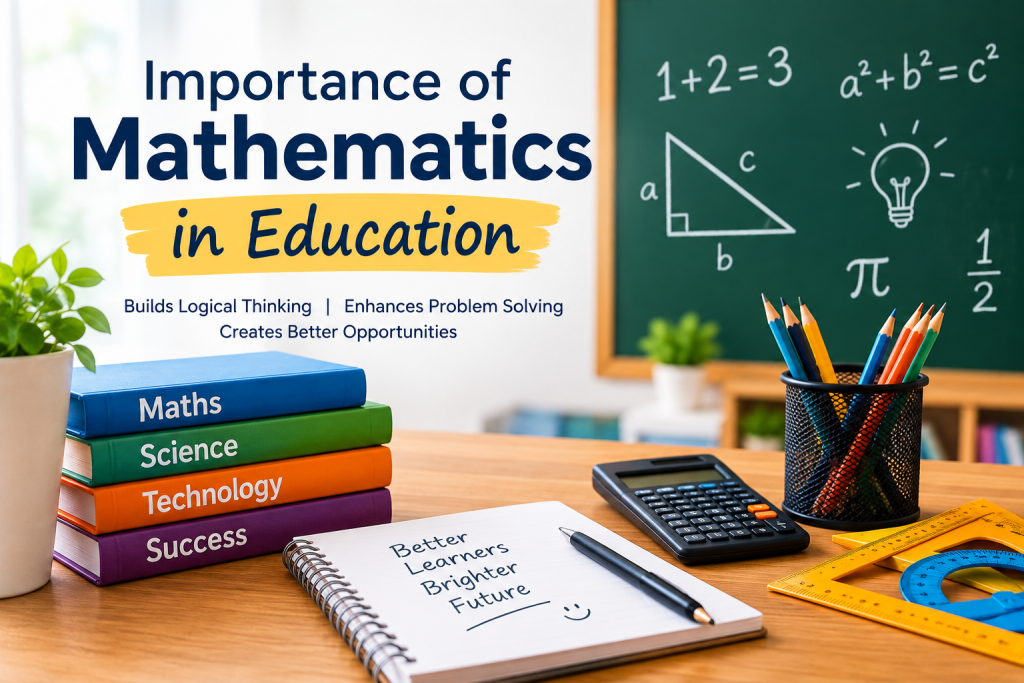
Mathematics is one of the most important subjects in education. It is often considered a subject of numbers, calculations, formulas, and equations, but its importance goes far beyond the classroom. Mathematics teaches students how to think logically, analyse situations, solve problems, make decisions, and understand the world around them. From counting money and calculating time to designing buildings, developing technology, analysing scientific data, and running businesses, mathematics is present in almost every aspect of our lives.
Education is not simply about memorising facts. Its main purpose is to develop knowledge, skills, confidence, creativity, and the ability to deal with real-life challenges. Mathematics contributes greatly to all these areas. A strong mathematical foundation helps students become better learners and prepares them for higher education, professional careers, and responsible everyday life.
1. Mathematics Develops Logical Thinking
One of the most important contributions of mathematics to education is the development of logical thinking. Mathematical problems usually require students to understand a situation, identify the available information, follow a sequence of steps, and reach a logical conclusion.
When students regularly practise mathematics, they learn to think before arriving at an answer. They begin to understand that a problem can often be approached in different ways and that conclusions should be supported by facts and reasoning.
For example, when solving a word problem, students must first understand what is being asked, determine which information is relevant, choose an appropriate mathematical operation, and then verify the answer. This process develops a systematic way of thinking that can be applied to many other areas of life.
2. Mathematics Improves Problem-Solving Skills
Problem-solving is an essential skill for every individual. Life presents different types of challenges, and people need to find practical solutions to overcome them. Mathematics provides students with regular opportunities to practise this skill.
Mathematical problems teach students not to give up when the answer is not immediately obvious. They learn to try different methods, identify mistakes, and find alternative solutions. This develops patience, persistence, and confidence.
The problem-solving skills gained through mathematics can be useful in science, business, technology, management, and even personal decision-making. A student who learns how to approach a difficult mathematical problem logically may also become more comfortable dealing with difficult situations outside the classroom.
3. Mathematics Is Essential in Everyday Life
Many people use mathematics every day without even realising how frequently they depend on it. Shopping, budgeting, cooking, travelling, measuring, calculating time, comparing prices, and managing household expenses all involve mathematics.
For example, when a person goes shopping, they may calculate discounts, compare the prices of different products, estimate the total bill, and check the change received. Similarly, when managing a monthly budget, a person needs to understand income, expenses, savings, percentages, and balances.
Students therefore need mathematics not only to pass examinations but also to become independent and capable individuals. Practical mathematical knowledge helps people make sensible financial and everyday decisions.
4. Mathematics Builds Financial Awareness
Financial literacy is becoming increasingly important in modern society. Students eventually need to understand salaries, savings, bank accounts, loans, interest rates, taxes, investments, insurance, and household budgets.
Mathematics provides the foundation for understanding these concepts. Knowledge of percentages, ratios, averages, interest, and basic calculations can help individuals make informed financial decisions.
For example, understanding compound interest can help a student appreciate the importance of saving early. Similarly, knowledge of percentages can help people understand discounts, loan costs, and price increases.
Thus, mathematics contributes to financial responsibility and prepares students for adult life.
5. Mathematics Supports Science and Technology
Mathematics is often described as the language of science. Almost every scientific field uses mathematical concepts to measure, calculate, analyse, and interpret information.
Physics uses mathematics to describe motion, energy, force, and electricity. Chemistry uses calculations to understand quantities and chemical reactions. Biology uses statistics and mathematical models to analyse populations, genetics, and scientific data.
Modern technology also depends heavily on mathematics. Computer programming, artificial intelligence, data science, robotics, engineering, cybersecurity, and digital communication all involve mathematical concepts.
As technology continues to influence education and employment, mathematical skills are becoming increasingly valuable.
6. Mathematics Encourages Accuracy and Attention to Detail
Mathematics teaches students the importance of accuracy. A small error in a calculation can produce an incorrect result. Therefore, students learn to read questions carefully, follow instructions, perform calculations accurately, and check their answers.
This attention to detail is valuable in many professions. Engineers, doctors, accountants, architects, scientists, technicians, and computer professionals all need accuracy in their work.
Even outside professional life, being careful with numbers and information can prevent mistakes. Mathematics therefore helps develop a habit of careful and responsible work.
7. Mathematics Develops Patience and Perseverance
Not every mathematical problem can be solved immediately. Some problems require several attempts before the correct solution is found. This teaches students an important lesson: difficult tasks require patience and consistent effort.
When students make mistakes in mathematics, they can learn from those mistakes and try again. Gradually, they understand that making an error does not mean failure. Instead, it can be an opportunity to understand the concept better.
This attitude towards challenges can benefit students throughout their education and future careers. Mathematics helps develop a growth-oriented mindset in which effort and practice are seen as important parts of learning.
8. Mathematics Strengthens Memory and Concentration
Learning mathematical concepts requires students to remember formulas, rules, relationships, and procedures. Regular mathematical practice can help students improve concentration and mental discipline.
For younger children, activities involving counting, patterns, shapes, and simple calculations can make learning mathematics interesting while developing their cognitive abilities.
As students progress to more advanced topics, they learn to concentrate on a problem for longer periods. This ability to focus can also support learning in other subjects.
9. Mathematics Helps Students Understand Patterns
Mathematics is closely connected with patterns. Students encounter patterns in numbers, shapes, sequences, measurements, and graphs. Learning to recognise patterns helps them predict what may happen next and understand relationships between different elements.
Pattern recognition is also important in computer science, science, economics, statistics, and many other fields.
For example, students may identify patterns in a sequence of numbers or observe relationships between variables in a graph. These activities develop analytical thinking and encourage curiosity.
10. Mathematics Supports Other School Subjects
Mathematics does not exist separately from other subjects. It supports learning across the curriculum.
In science, students use measurements, graphs, formulas, and calculations. In geography, they use scales, distances, maps, statistics, and population data. In economics and commerce, mathematics is essential for understanding prices, profits, losses, interest, and financial information.
Even subjects such as art and physical education can involve mathematical ideas. Art may use symmetry, proportion, shapes, and geometry, while sports involve scores, measurements, averages, statistics, distance, and time.
Therefore, developing mathematical ability can strengthen a student's overall academic performance.
11. Mathematics Prepares Students for Future Careers
A strong foundation in mathematics can open doors to many career opportunities. Careers in engineering, architecture, medicine, information technology, finance, banking, accounting, research, statistics, economics, data science, and many technical fields require mathematical knowledge.
However, mathematics is not useful only for traditionally technical careers. Business owners, managers, teachers, designers, marketers, and entrepreneurs also use mathematics to understand costs, sales, profits, data, and planning.
In an increasingly data-driven world, the ability to understand numbers and interpret information is becoming an important professional skill.
12. Mathematics Builds Confidence
Students sometimes develop a fear of mathematics because they find certain concepts difficult. However, with appropriate teaching methods, regular practice, encouragement, and real-life examples, students can overcome this fear.
Solving a difficult problem successfully gives students a sense of achievement. Each small success can increase confidence and encourage them to take on more challenging tasks.
Teachers and parents have an important role in creating a positive attitude towards mathematics. Instead of presenting mathematics only as a subject of examinations, they can show students how mathematical concepts are connected with real-life situations.
13. Importance of Teachers in Mathematics Education
The quality of mathematics education depends greatly on the way the subject is taught. Teachers can make mathematics more interesting by connecting lessons with practical examples and activities.
Instead of simply asking students to memorise formulas, teachers can explain why a formula works and where it can be used. Games, puzzles, models, group activities, visual demonstrations, technology, and real-life examples can make mathematical learning more engaging.
Different students learn at different speeds. A good mathematics teacher recognises these differences and provides appropriate support and encouragement. The objective should not only be to obtain correct answers but also to help students understand the process behind those answers.
14. Role of Parents in Developing Mathematical Skills
Parents can also help children develop a positive attitude towards mathematics. Simple activities at home can provide valuable learning opportunities.
Parents can involve children in calculating shopping bills, measuring ingredients while cooking, planning travel time, counting objects, comparing prices, or managing small budgets. Such activities demonstrate that mathematics is not limited to textbooks.
Parents should also encourage children when they make mistakes. Creating a supportive environment can help students develop confidence rather than fear.
15. Mathematics and Critical Thinking
In today's world, students receive large amounts of information through television, newspapers, websites, and social media. They need the ability to decide whether information is reliable and meaningful.
Mathematics and statistics help students interpret numbers, percentages, charts, graphs, and data. This develops critical thinking and helps them question misleading or incomplete information.
For example, a percentage displayed in an advertisement may appear impressive, but understanding the actual numbers behind it can help a person make a more informed judgement.
Thus, mathematical literacy is increasingly important in the digital age.
16. Making Mathematics More Interesting
Mathematics should not be presented as a subject that students simply have to memorise. It can be made enjoyable through practical activities, puzzles, competitions, experiments, educational games, and technology.
Teachers can use real-life examples such as shopping discounts, sports statistics, architecture, cooking measurements, weather data, and business calculations to explain mathematical concepts.
When students understand the purpose behind what they are learning, they are more likely to develop curiosity and interest in the subject.
Conclusion
Mathematics is much more than a subject taught in schools. It is a fundamental skill that helps students understand numbers, patterns, relationships, measurements, data, and logical reasoning. It develops problem-solving ability, concentration, accuracy, patience, critical thinking, and confidence.
Its importance extends from everyday activities to advanced science, technology, business, medicine, engineering, finance, and research. A strong foundation in mathematics can help students become better learners and prepare them for a wide range of future opportunities.
The goal of mathematics education should therefore be to help students understand not only how to calculate, but also how to think, analyse, question, and solve problems. When mathematics is taught with practical examples, encouragement, creativity, and understanding, it can become an exciting and meaningful part of a student's educational journey.
Ultimately, mathematics gives students a powerful tool for understanding the world and making informed decisions. The mathematical skills developed during school years can remain valuable throughout life, making mathematics one of the most important foundations of quality education.